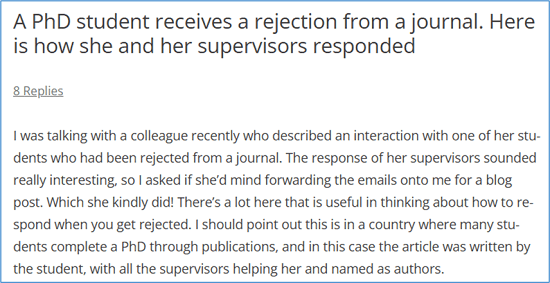
悉尼科技大学国际研究与教育学院的Nick Hopwood教授分享了一组极具启发性的师生邮件往来。
Hopwood教授长期致力于研究学习与能动性之间的联系,他认为在教育过程中,如何创造条件让学习者在挫败中恢复能动性至关重要。
这组邮件,正好提供了一个非常具体且典型的案例。
1 学生的邮件
在以论文成果作为毕业硬性要求的背景下,一位博士生在三位导师联合指导下独立完成论文创作,文章由本人主笔,导师团队共同署名投稿。
论文投稿六个月后,期刊正式发来拒稿通知。学生把拒稿结果转发给了导师,并写了一封邮件:
Dear supervisors,
At last I have got response from the journal regarding my second manuscript. Unfortunately they are not interested to publish it.
I'm very disappointed about that. I can agree with a lot of the comments, it is useful for me in the future process but it has taken over 6 months to deliver that answer and right now I don't have so much positive energy to restart the work.
I think I can interpret their comments (at least from the first reviewer) as if I rewrite the manuscript I can try to resubmit it but I'm not really sure if that is their suggestion.
在邮件中,她说明了自己现在的状态,没有精力继续推进这篇论文。同时,也表达了自己对审稿意见的疑惑,不知道是不是要重写后重新投稿。
2 导师A的回信
导师A的回复很长,也是相当重要的一封回信。
她首先接住了学生的情绪,然后表明问题不是研究不行,而是这篇论文还没把它写好。
Thank you for your email. Yes that is somewhat disappointing, but from the comments, perhaps it is good that it isn't published in its current form: because from what the reviewers saw, I don't think the paper did full justice to your work and your thinking! Better to have a stronger paper published, even if it is later.
接着,她做了三件很关键的事:
1) 帮学生指出积极信号
导师指出审稿人看得很仔细,意见也是清晰、可用的。这一步,是给学生建立一个更准确的判断,过滤掉负面情绪。
I have had similarly prickly experiences, particularly in this journal, with reviewers who really want accounts of research to feel as if the research was quantitative (a bit like reviewer 1 worrying about interpretation in ethnographic research etc).
On the plus side:
● Both reviewers appear to have read your paper in quite a bit of detail! (which is not always the case)
● Both reviewers have offered well-written comments that are quite easy to understand (which is not always the case)
● There is lots in the comments that will help to improve the paper.
2) 帮学生读懂审稿意见
研究本身没被否定,主要问题在表达与结构上:
● 方法不够具体;
● 逻辑链不够清晰(问题—理论—结果—讨论);
● 创新点不够明确。
而且这些都属于可以通过修改解决的问题,不需要推翻重来。
I think both the reviewers offer largely helpful comments – they are not fighting the kind of story you want to tell, or questioning its importance. They do want to know more concrete detail about the study methods, want a clearer alignment between the question, theory, findings and discussion, and a very clear argument as to what is new and why it matters. They are all very achievable without having to go back and do more analysis!
3) 给出具体行动路径
导师没有停留在分析,而是直接给出行动建议:
● 先缓一缓,再开始;
● 考虑有没有可以替代的期刊(而不是纠结是否重投);
● 列出审稿意见中值得改动的意见。
将学生情绪上的问题,转换为具体可执行的任务。
I think the process now should be to wait a few days until you feel a bit less fed up, and then to start:
● Thinking of alternative journals (although R1 seemed to invite this the journal is definitely not asking for a resubmission as I interpret the email). XXX might be one possibility. Or YYY?
● Coming up with your own to-do list in terms of changes you think are worth making to the paper – and perhaps differentiating those that are small/easy, and those that require a bit more thought and work. You can also list those points the reviewers made that you're not so bothered about and don't want to make big changes.
3 导师B的回复
导师B的重点不在怎么改,而在什么时候改。
I understand that it feels a bit disappointing, particularly since they kept you waiting so long for the decision. But I can only echo what [Supervisor 1] is suggesting, once you have worked through the comments, your paper will be much stronger. I think you should let it sit while you are completing the paper on the [different analysis], you are in a good flow with that one at the moment! And we should think of an alternative journal, I agree, we need to aim for one that is included in Web of Science.
导师B没有让学生马上修改,而是建议学生先把另一篇进展顺利的论文做完。
这样做的意义在于:
● 不打断已经形成的科研节奏;
● 让自己从负面情绪中抽离出来。
同时也提醒学生,选期刊要考虑是否被Web of Science收录。
有些时候,当我们陷入负面情绪时,强行继续做可能会事倍功半。
4 导师C的回复
导师C的回应很简短,但同样也起到了很大的作用。
This is the kind of experience that is not only sometimes happening, but rather a rule than an exception. And just as S1 and S2 state; it will in the end improve the paper. But I do agree they could have given us this feedback at least half a year earlier….
I also think S2's advice is right; go on with the paper on [different analysis] and let this paper rest (just like a wine; it will become better with time and maturation.).
So let this experience take its time and aim for a journal that is indexed in Web of Science, although the IF is not too important.
他先说明拒稿的常态化,还将好论文比作红酒,需要花时间去等待。也是安慰学生不要太心急,可以先转移注意力做其他的事,过段时间再修改这篇论文,效果会更好。
5 学生的回应
在导师们回复之后,学生的状态发生了变化。
Thanks for the support!
I totally agree with you all and as I said, the comments from the reviewers are very good for me in the future process and also for my paper regarding the [different analysis]. I struggle with the same issues here I guess; clear arguments for the study, evidence for my findings and how to discuss that much more clear.
她开始意识到:这不是一篇论文的问题,而是自己在写作中的共性问题。也知道了后续修改的方向。
6 被拒稿后,该如何应对?
Nick Hopwood教授分享的这段邮件,展示了高效的学术团队收到拒稿后的应对措施。
1) 学生愿意表达真实状态
学生没有硬扛,而是敢于直接表达自己的状态。这反而让导师能够提供更精准有效的建议。
2) 结构性的学术支持
导师没有说审稿人不行,也没有人要求学生立刻重投。而是迅速将话题转向了如何利用现有的高质量审稿意见。
不仅是安慰学生,还进行了具体指导:
● 解读审稿人意见;
● 制定具体的To-do List;
● 稳住科研节奏。
被拒稿后,到底该怎么办?这组邮件给出了一个参考顺序:
● 先整理情绪,而不是马上投入修改;
● 冷静读懂审稿意见;
● 拆解成具体的修改任务并完善论文;
● 重新评估更适合的目标期刊;
● 保持整体科研节奏。
如果需要论文润色和投稿指导等服务,欢迎扫描下方二维码,关注公众号【埃米编辑SCI论文润色】-点击个人中心-联系埃米客服了解详情~回复“礼包”,可免费领取100+写作投稿资料包和投稿问题30问~

参考资料:
[1] https://nickhop.wordpress.com/2014/12/18/a-phd-student-receives-a-rejection-from-a-journal-here-is-how-she-and-her-supervisors-responded/